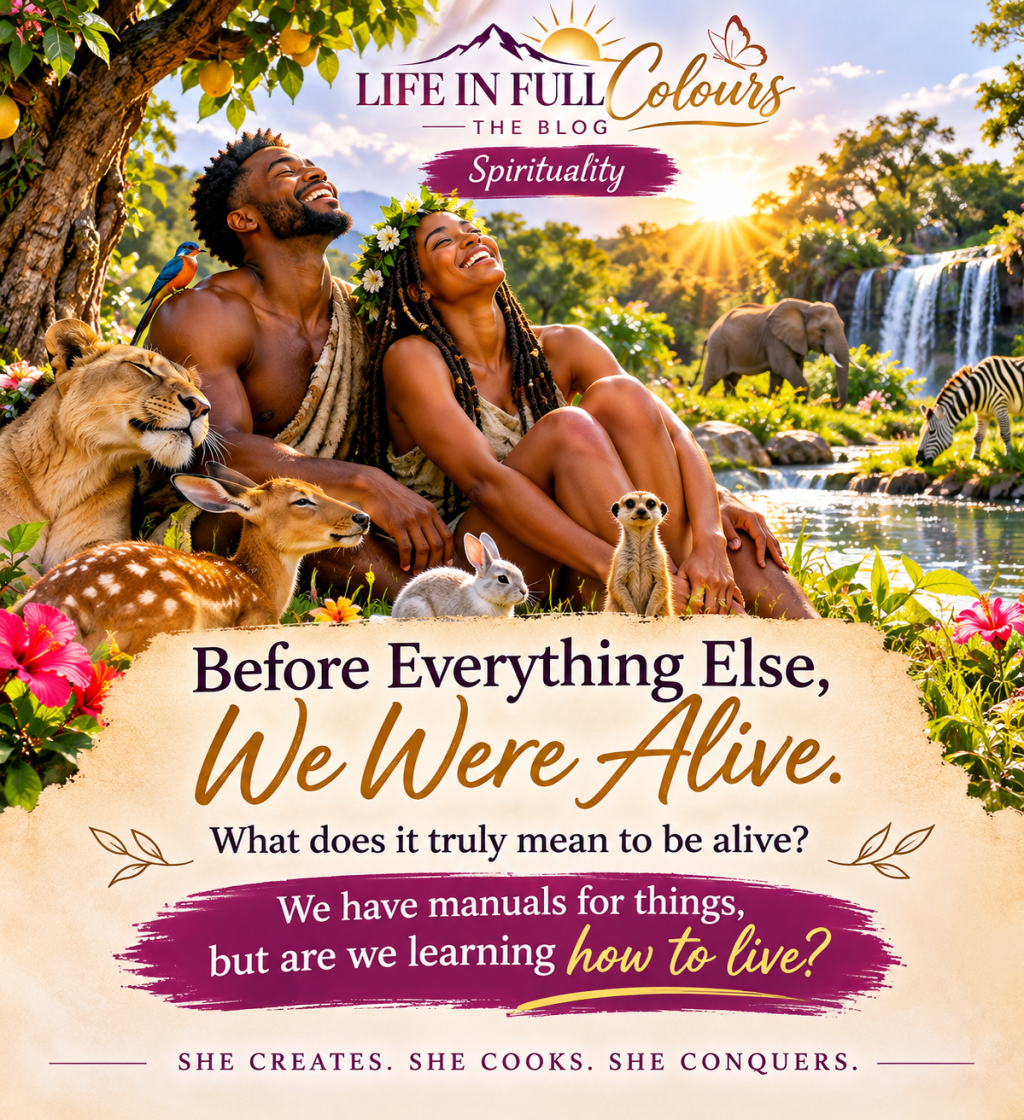
Life in Full Colours | Spirituality
What does it truly mean to be alive?
Imagine waking up tomorrow with absolutely nothing.
No money in your bank account. No beautiful clothes hanging in your wardrobe. No car parked outside. No job title, no business, no house to call your own, no phone, no possessions and no material evidence of the life you have worked so hard to build.
What would remain of you? Would you still know who you are? Would you still find a reason to smile? Would you still understand the meaning of being alive?
Before the world introduced us to money, status, fashion, careers, houses, cars and all the things we have come to measure our success by, there was life.
There was our mother. There was our father. There was the earth beneath our feet, the trees above our heads, the sun that warmed our skin, the moon that illuminated our nights, the stars that decorated our darkness, the air that entered our lungs and the water that sustained our bodies.
There were birds singing without an audience. Rivers flowing without asking for payment. Trees growing without demanding recognition. Flowers blooming without needing anyone to admire them.
There was a world already functioning before we ever learnt how to put a price on anything. And somehow, we have become so occupied with acquiring things that we have forgotten to appreciate what was here before us.
The things we were given without a price tag
Think about it. Nobody sent us an invoice for the first breath we took. Nobody asked us to pay for the sunlight that touched our faces. Nobody charged us for the moonlight, the sound of rain, the smell of fresh soil after a storm or the feeling of a gentle breeze against our skin.
We inherited a world full of wonders. The trees give us shade, oxygen and life. Water sustains us. The sun supports life on earth. The moon and stars have inspired human beings to observe, wonder and find meaning in the universe.
Nature has been speaking a language long before we developed our own. But do we listen?
Do we ever sit beneath a tree without looking at our phones? Do we watch a sunset without trying to photograph it? Do we listen to the rain without immediately thinking about the inconvenience it brings? Have we become so accustomed to the extraordinary that we now call it ordinary?
We are part of what we keep overlooking
Perhaps one of the greatest misunderstandings of human existence is the idea that we are separate from nature. We are not merely visitors on this earth. We are part of it.
The air we breathe connects us to the atmosphere. The water within our bodies connects us to the water cycle. The food we eat comes from the earth. Our bodies depend on natural systems that existed long before our buildings, businesses and technology.
We are not outside the natural world, observing it from a distance. We belong to it.
And yet, we often treat the very things that sustain us as though they are endless, replaceable or unimportant. We cut down trees and complain about the heat. We pollute rivers and wonder why clean water is becoming difficult to access. We destroy natural spaces and then search for places where we can experience peace.
Perhaps we should ask ourselves whether we have forgotten how deeply our existence is connected to the environment around us.
What about the things we cannot touch?
There is another inheritance we rarely discuss: our intuition, our emotions, our dreams, our curiosity, our ability to love, to imagine, to create, to feel and to wonder.
These things cannot be bought from a shop. You cannot purchase genuine intuition. You cannot put a price on the feeling of love. You cannot order a meaningful dream or buy the comfort of knowing that you are connected to something greater than yourself.
Our emotions tell us something about our experiences. Our dreams invite us to imagine possibilities. Our intuition can encourage us to pause, reflect and pay attention to what we are experiencing.
Yet, how often do we silence ourselves? How often do we ignore our feelings because we are too busy surviving? How often do we abandon our dreams because society has convinced us that only certain achievements make us valuable?
We spend years learning how to operate machines, navigate systems, follow instructions and understand man-made structures. Most things we manufacture come with a manual.
But where is the manual for being human? Where is the instruction book for understanding grief, love, purpose, intuition, forgiveness, connection and the mystery of existence?
Perhaps part of being alive is learning to pay attention, to observe, to question and to discover.
We have manuals for things, but are we learning how to live?
We have manuals for cars, appliances, computers and countless other inventions. We know how to charge a phone, operate a machine, open a bank account and follow a career path.
But do we know how to sit with ourselves? Do we know how to be still? Do we know how to appreciate a moment without needing to own it? Do we know how to find joy when there is nothing new to purchase?
We have become very good at building lives, but perhaps we have not spent enough time understanding life itself.
We chase comfort, yet sometimes struggle to find peace. We chase recognition, yet forget to recognise ourselves. We collect possessions, yet neglect the experiences that make existence meaningful. And while we are busy chasing tomorrow, today quietly passes us by.
So, what do we do with the life we have been given?
Perhaps we begin by returning to the basics. We spend time outdoors. We plant something and watch it grow. We protect our water. We appreciate the people who brought us into this world, where possible. We listen to our bodies. We make room for our emotions. We give ourselves permission to dream.
We learn to be grateful without becoming complacent. We pursue our ambitions without allowing material possessions to define our worth.
We can love beautiful clothes, drive beautiful cars, build businesses, earn money and enjoy the comfort of a good life. There is absolutely nothing wrong with that. But we must remember that these things are additions to our existence, not the definition of it.
A person without a car is still a person. A person without a job title still has worth. A person without expensive clothing still deserves dignity. A person who has lost everything material has not necessarily lost the most important thing: the possibility of experiencing life.
Perhaps we should stop postponing happiness until we have acquired everything we think we need.
The sun is already rising. The moon is already appearing. The trees are still growing. The air is still moving. Somewhere, water is flowing. Somewhere, a bird is singing.
Life is happening, even when we are not paying attention.
Before everything else, you were alive.
I wonder what would happen if we started measuring our lives differently.
Not by how much money we have, but by how deeply we experience life. Not by the number of things we own, but by how much we appreciate what cannot be owned. Not by the titles we carry, but by the people we become. Not by how impressive our lives look from the outside, but by how meaningful they feel on the inside.
Maybe the question is not simply what we want to achieve before we die. Maybe the question is:
Are we truly living while we are here?
Because before the money, before the clothes, before the cars, before the jobs, before the houses and before everything humanity has built, there was life.
And we were already part of it. Perhaps it is time we remembered.
— Life in Full Colours
She Creates. She Cooks. She Conquers.


Leave a Reply